The Promised Lamb, a Passover seder
guide and teaching booklet (Simplified)
https://www.restorembi.com/Promised-Lamb-seder-simplified.htm
https://www.restorembi.com/Promised-Lamb-seder-simplified.pdf
More resources here: https://www.incpu.org/Hebrew.htm
This is the abbreviated
version. Some Passovers can be over an hour long or a bit longer, but this
should be 30 minutes to an hour. We do not do this to “keep the law” and “earn
salvation”. We do this to let God use His Word to remind us of holiness, His
pure character, and how we can be more like Him and follow His ways – our
thoughts, words, attitudes and actions. Two words you will want to know:
Haggadah = “the telling”, and Seder (or Siddur) = “order”, meaning the telling
of the story and teachings, and the order of the festival and meal.
This is the shortened
version, but it is also forward looking. It looks not only on God’s
establishment of sacrifices to cover our sins, but also on His promises of
sending a Messiah and Deliverer. In it, we briefly quote many passages from the
Tanakh that we have not seen in any other Passover Seder booklet.
Let’s start with prayer. God
we thank You for using Your Word to help us understand You, Your Word and the
world around us. Teach us as we use this Passover seder
to remember the important things. In Jesus’ Name, we pray. Amen.
So,
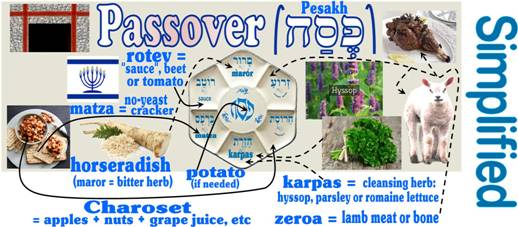
there are 6 things on your seder plate. Each of them
has a meaning and a reminder from Scripture. There are many Scripture verses
for each, but this will give you a short few verses to remember and explain in
brief. Let’s begin.
>>
Options: You could include 2 glasses of grape juice, one
to start, and one to end (like Yeshua/Jesus did at the Lord’s Supper). We also suggest singing at least 2 or 3
songs, or more if it’s longer.
Charoset
(sweet dark paste reminding of mortar for bricks, typically made of vinegar,
apples, and pecans or other nuts)
-
[sounds like “care-oh-set”], חַרוֹסֶת
This
is a reminder of the hard work of slavery in Egypt, before God rescued the
people of Israel and took them to the Promised Land, Israel. Jacob/Israel, by
God’s leading, went down to Egypt to dwell during a famine, stayed with the
blessing and provision of Pharaoh and God’s leading through Joseph. 400 years
later, there was no Pharaoh who knew of Joseph, and they started to oppress the
people of Israel, forcing them to do very hard slave labor, making bricks,
baking them, and then building buildings and possibly the smaller pyramids made
of stacked bricks and mortar. The Charoset reminds us of the bricks and mortar
and the bitterness of slavery.
God
said to Abraham when He was making the unconditional covenant with him: “13 Then He
said to Abram: "Know certainly that your descendants will be strangers in
a land that is not theirs, and will serve them, and they will afflict them four hundred years. 14 And also the
nation whom they serve I will judge; afterward they shall come out with great
possessions.” (Genesis 15:13)
>>
Let’s eat a little of the Charoset as we remember the 400+ years the people of
Israel were slaves in Egypt. (eat a taste or spoonful
of Charoset)
***~~***
Maror
(bitter herbs, often horseradish)
-
[sounds like “mah-roar”], םָרוֹר
This
is a reminder of the bitterness of trials and slavery. Bitter herbs are
healing, but not easy to eat. Same with trials. Trials
and hardships are not fun at first but they do help us find God and gain wisdom
and understanding. So, they have a bitter start, but healthy conclusion.
“8 Then they
shall eat the flesh of the lamb on that night; roasted in fire, with unleavened
bread and with bitter herbs they shall eat it.” (Exodus 12:8)
“9 Furthermore,
we have had human fathers who corrected us, and we paid them respect. Shall we
not much more readily be in subjection to the Father of spirits and live? 10 For they indeed for a few days chastened us as seemed best
to them, but He for our profit, that we may be partakers of His holiness. 11 Now
no chastening seems to be joyful for the present, but painful; nevertheless,
afterward it yields the peaceable fruit of righteousness to those who have been
trained by it.” (Hebrews 12:9-11)
>>
Let’s eat just a nibble of horse-radish. Be careful, if you’re not used to it -
it’s spicy.
>>>
the suggestion of potato in the middle in case someone
needs to cool off their tongue.
***~~***
Matza/Matzoh
(baked flat unsalted unleavened bread)
-
[sounds like “mah-tzah”], מַצָה
God told the people of Israel to make crackers without yeast,
so they would be quick to bake so they could be ready to leave in the morning. In
teaching this, God also taught them to remove all “leaven” from their house, as
a reminder to grow in removing sin from our lives and hearts and homes. This is
an important reminder once a year, and more.
“15 Seven days you shall eat
unleavened bread. On the first day you shall remove leaven from your houses.
For whoever eats leavened bread from the first day until the seventh day, that
person shall be cut off from Israel.” (Exodus 12:15)
“17 So you
shall observe the Feast of Unleavened Bread, for on this same day I will have
brought your armies out of the land of Egypt. Therefore you shall observe this
day throughout your generations as an everlasting ordinance.”
(Exodus 12:17)
>> Let’s all break off and eat a piece of the
matza.
***~~***
Karpas, Parsley (bitter herb, reminder of cleansing and
purifying), כַּרְפַס
- [sounds like: “kar-pass”] (parlsey
is a normal replacement for hyssop)
Hyssop is an herb that is still known for cleansing and
purifying. It is not as easy to find, so many Jews will replace it with
parsley. Its purpose on the seder plate is to remind us that God wants to purify us from
sin, so we can walk pure and upright before Him.
“8 This Book of
the Law shall not depart from your mouth, but you shall meditate in it day and night,
that you may observe to do according to all that is written in it. For then you
will make your way prosperous, and then you will have good success.”
(Joshua 1:8)
“7 Purge me with hyssop, and I shall be
clean; Wash me, and I shall be whiter than snow.” (Psalm
51:7)
“5 I
acknowledged my sin to You, And my iniquity I have not
hidden. I said, "I will confess my transgressions to the LORD," And You
forgave the iniquity of my sin.” (Psalm 32:5)
“9 How can a young man cleanse his way? By taking heed according to Your Word. 10 With my whole heart I have sought You; Oh, let me not wander
from Your commandments! 11 Your Word I have hidden in my heart,
That I might not sin against You!” (Psalm
119:9-11)
>> Let’s eat a little parsley (or hyssop) while we think
on those verses.
***~~***
Zeroa
(pieces of lamb)
-
[sounds like: “zeh-roh-ah”], זְרוֹעַ
This
is one of the most important parts, the piece of lamb. This is, I believe, the
key part of the whole Passover service. Why? Because of the
meaning of a sacrificed lamb. Let us first look at what God said to
Moses about the lamb.
“5 Your lamb shall be without blemish, a male of the first year.
You may take it from the sheep or from the goats. 6 Now
you shall keep it until the fourteenth day of the same month. Then the whole
assembly of the congregation of Israel shall kill it at twilight. 7 And they shall take some of the blood and
put it on the two doorposts and on the lintel of the houses where they eat it. 8 Then they shall eat the flesh on that
night; roasted in fire, with unleavened bread and with bitter herbs they shall
eat it.”
(Exodus 12:3-25)
One
brief note on the shank bone – it needs to be unbroken, as God commanded Israel
through the Prophet Moses in Exodus 12. Cut clean at the joint is fine, but it
needs to be unbroken, as in not broken.
“46 In
one house it shall be eaten; you shall not carry any of the flesh outside the
house, nor shall you break one of its bones. 47 All the
congregation of Israel shall keep it.” (Exodus 12:46-47)
(See
also 2 Chronicles 35:10-19)
So, quick review. God started the sacrifices
on the same day that Adam and his wife Chava/ “Eve” sinned. In an act of
kindness and grace, God killed a sheep or two and made comfortable and modest
clothing for both of them, and He also showed them how to do animal sacrifices,
which was a temporary covering for their sins. This was also a way to help them
remember to draw close to God often so that they cleanse their hearts and God
could speak to them. Also, God gave a promise and prophecy that one day, Jesus
would come to earth to take our place, so we could be saved and live with God
again. (Genesis 3)
Abel
continued raising sheep and doing sacrifices along with his Dad and Mom, by
faith in God and in the promises of God. But satan inspired
Cain to murder/kill Abel to try to stop this. But, those who loved God
continued this. We see Noah and his family did. And then again Abraham did too.
And God even spoke through Abraham that He would provide a lamb. We’ll look at
that more for the last part.
God
told His prophets promises and prophecies about the coming Messiah. Let’s look
at some of them.
“1 Who has believed our report? And to
whom has the arm of the LORD been
revealed? 2 For He shall grow up before Him
as a tender plant, And as a root out of dry ground. He has no form or
comeliness; And when we see Him, There is no beauty
that we should desire Him. 3 He is despised and rejected by men, A
Man of sorrows and acquainted with grief. And we hid, as it were, our faces
from Him; He was despised, and we did not esteem Him. 4 Surely He
has borne our griefs And carried our sorrows; Yet we
esteemed Him stricken, Smitten by God, and afflicted. 5 But He was
wounded for our transgressions, He was bruised for our iniquities; The chastisement for our peace was upon Him, And by His
stripes we are healed. 6 All we like sheep have gone astray; We have turned, every one, to his own way; And the LORD has laid on Him the iniquity of us
all. 7 He was oppressed and He was afflicted, Yet
He opened not His mouth; He was led as a lamb to the slaughter, And as a sheep
before its shearers is silent, So He opened not His mouth. 8 He was
taken from prison and from judgment, And who will
declare His generation? For He was cut off from the land of the living; For the transgressions of My people He was stricken. 9 And
they made His grave with the wicked-- But with the rich at His death, Because He had done no violence, Nor was any deceit in His
mouth.”
(Isaiah 53)
(See
also Daniel 9:20-27)
(See
also Daniel 2:31-45)
>>
Let’s eat a bite of lamb.
***~~***
Rotev
(sauce, tomato or beet, reminder of the covering blood of the Passover lamb)
[replace the egg with this] רוֹטֵב
-
[sounds like: “roh-tev”]
So,
this is the last part of the Passover seder. It is
tomato or beet sauce to remind us of the blood that was shed to cover our sins.
Some
of you may notice that I have slightly modified tradition here. This is new.
Please let me explain why I have added it. Having studied God’s Word since I was
young (Old and New Testament), I want to be more accurate to the heart of God
as explained in His Word, the Torah/Tanakh. Anyone may eat eggs of any sort at
the Passover meal, but it does deserve to be and should not be on the Passover
Seder plate. You will find that the egg does not get explained much, because it
simply doesn’t belong – it was supposedly added during or after the Babylonian
captivity. I strongly believe that it also doesn’t belong because I’m convince
that the egg has been included by Roman-Catholic agents within the teaching
hierarchy of Jewish rabbinical schools to coincide with the mystic and pagan
practices and traditions from ancient demonic mythologies, including Ishtar and
fertility cult customs (often spelled “Easter”). I believe where tradition
contradicts what God established and sanctified, then that is a tradition that
needs to removed and replaced or fixed/repaired to go back to God’s
arrangement, so that we are obeying and fearing and serving God and not man.
So,
we believe according to the Torah/Tanakh, that instead of the egg, we should
replace it with plain (or mildly seasoned) tomato sauce or beet sauce, as part
of the ceremony remembering the blood on the doorposts, the reason the Angel of
the Lord passed-over (Passover) the homes of our Jewish brethren who had
applied the blood of the lamb on their doorposts with the brushes made of
hyssop (Exodus 12:22). Which is directly referencing God’s
Word thru the Prophet David, the King.
“7 Purge me with hyssop, and I shall be
clean; Wash me, and I shall be whiter than snow.” (Psalm
51:7)
But
there is a deeper meaning here, one taught by Moses, and found through the
Tanakh (Old Testament), one that lying rabbis refuse to read or teach. The same
Messiah promised by God to Adam and his wife Chava, is the same Messiah spoken
of throughout Scripture, dozens of times, and the one we see fulfill over 300
prophecies in the Tanakh in the New Testament, specifically found in the Books
and records of Matthew, Mark, Luke, and John. Let’s look briefly at 2 of the
Messianic passages within the Book of Genesis.
As
God Himself said to Adam and Chava/”Eve”,
“9 Then the LORD God called to Adam and said to
him, "Where are you?" 10 So
he said, "I heard Your voice in the garden, and I was afraid because I was
unclothed; and I hid myself." 11 And
He said, "Who told you that you were unclothed? Have you eaten from the
tree of which I commanded you that you should not eat?" 12
Then the man said, "The woman whom You gave to be with
me, she gave me of the tree, and I ate." 13 And the LORD God said to the woman, "What is this you have
done?" The woman said, "The serpent deceived me, and I ate."
“14 So
the LORD God said to the serpent:
"Because you have done this, You are cursed more than all cattle, And more
than every beast of the field; On your belly you shall go, And you shall eat
dust All the days of your life. 15 And
I will put enmity Between you and the woman, And between your seed and her
Seed; He shall bruise your head, And you shall bruise His heel." 16 To the woman He said: "I will
greatly multiply your sorrow and your conception; In pain you shall bring forth
children; Your desire shall be for your husband, And he shall rule over
you."
“17 Then
to Adam He said, "Because you have heeded the voice of your wife, and have
eaten from the tree of which I commanded you, saying, 'You shall not eat of
it': "Cursed is the ground for your sake; In toil you shall eat of it All
the days of your life. 18 Both thorns
and thistles it shall bring forth for you, And you shall eat the herb of the
field. 19 In the sweat of your face you shall eat bread Till
you return to the ground, For out of it you were taken; For dust you are, And
to dust you shall return." ” (Genesis 3:13-19)
--
Note, God said He Himself would provide a coming Deliverer. But
who?
Abraham,
a prophet and servant of God, spoke by God’s direction of God providing a lamb
for the sacrifice, which God did. God was testing Abraham’s faith, but also
showing a pattern of prophecy of a coming Messiah and Deliverer. Abraham was
the first and only person whom God made an unconditional covenant with,
including a large section of the Middle East as part of that covenant, which
was then passed on directly by God to Isaac and Jacob/Israel.
“7 But Isaac
spoke to Abraham his father and said, "My father!" And he said,
"Here I am, my son." Then he said, "Look, the fire and the wood,
but where is the lamb for a burnt offering?" 8 And
Abraham said, "My son, God will provide for Himself the lamb for a burnt
offering." So the two of them went together.” (Genesis
22:7-8)
Then
Moses said: “15 The LORD
your God will raise up for you a Prophet like me from your midst, from your
brethren. Him you shall hear, 16 according to all you desired of the
Lord… 18 I will raise up for them a Prophet like you from among
their brethren, and will put My words in His mouth, and He shall speak to them
all that I command Him. 19 And it shall be that whoever will
not hear My words, which He speaks in My name, I will
require it of him.” (Deuteronomy 18:15-19)
But
then God is 100% clear here, when He speaks through His prophet Isaiah. Let us
review this again:
“1 Who has believed our report? And to whom has the arm of the LORD been revealed? 2 For He shall grow up before Him as a tender plant, And as a
root out of dry ground. He has no form or comeliness; And
when we see Him, There is no beauty that we should desire Him. 3 He
is despised and rejected by men, A Man of sorrows and acquainted with grief.
And we hid, as it were, our faces from Him; He was despised, and we did not
esteem Him. 4 Surely He has borne our griefs And
carried our sorrows; Yet we esteemed Him stricken, Smitten by God, and
afflicted. 5 But He was wounded for our transgressions, He was
bruised for our iniquities; The chastisement for our
peace was upon Him, And by His stripes we are healed. 6 All we
like sheep have gone astray; We have turned, every
one, to his own way; And the LORD
has laid on Him the iniquity of us all. 7 He was oppressed and He was
afflicted, Yet He opened not His mouth; He was led as
a lamb to the slaughter, And as a sheep before its shearers is silent, So He
opened not His mouth. 8 He was taken from prison and from judgment, And who will declare His generation? For He was cut off from
the land of the living; For the transgressions of My
people He was stricken. 9 And they made His grave with the
wicked-- But with the rich at His death, Because He
had done no violence, Nor was any deceit in His mouth.” (Isaiah 53)
That
is Jesus – not the white European Catholic cult version of Jesus, but the real
one, Yeshua HaMashiach, Jesus the Jewish rabbi, and the Messiah/Christ for Jews
and Gentiles. Jesus came, to earth, added a body to Himself, walked among us,
as He did in the days of Melchizedek (King of Salem). Yet, this time, He came
to take away the sins of the world. God did not die, but Jesus’ human body died
in our place – taking our punishment for our sin.
And
again through Isaiah, God speaks:
“1 "Comfort, yes, comfort My people!" Says
your God. 2 "Speak comfort to Jerusalem, and cry
out to her, That her warfare is ended, That her
iniquity is pardoned; For she has received from the LORD'S hand Double for all her sins." 3 The
voice of one crying in the wilderness: "Prepare the way of the LORD; Make straight in the desert A highway for our God. 4 Every valley shall be
exalted And every mountain and hill brought low; The crooked places shall be
made straight And the rough places smooth; 5 The glory of the LORD shall be revealed, And all flesh
shall see it together; For the mouth of the LORD
has spoken."” (Isaiah 40:1-5)
That
prophet whom God through Isaiah spoke of, was a man named John the Baptizer,
who was the forerunner of Jesus. John the Baptizer said this of Jesus:
“29 The
next day John saw Jesus coming toward him, and said, "Behold! The Lamb of
God who takes away the sin of the world! 30 This is He of whom
I said, 'After me comes a Man who is preferred before
me, for He was before me.' 31 I did not know Him; but that He
should be revealed to Israel, therefore I came baptizing with water." 32 And
John bore witness, saying, "I saw the Spirit descending from heaven like a
dove, and He remained upon Him. 33 I did not know Him, but He
who sent me to baptize with water said to me, 'Upon whom you see the Spirit
descending, and remaining on Him, this is He who baptizes with the Holy
Spirit.' 34 And I have seen and testified that this is the Son
of God."” ()
As
God said through the prophet/writer of Proverbs:
“4 Who has ascended into heaven, or descended? Who has gathered the wind in
His fists? Who has bound the waters in a garment? Who has established all the
ends of the earth? What is His name, and what is His Son's name, If you know?” (Proverbs 30:4)
And
God through Daniel said the Messiah would be cut off. There is only One person
who fits all of these descriptions:
“24 "Seventy weeks of years are determined by God for your people and for
your holy city, To finish the transgression, To make an end of sins, To make
reconciliation for iniquity, To bring in everlasting righteousness, To seal up
vision and prophecy, And to anoint the Most Holy. 25 Know
therefore and understand, That from the going forth of the command To restore
and build Jerusalem Until Messiah the Prince, There shall be seven weeks and
sixty-two weeks; The street shall be built again, and the wall, Even in
troublesome times. 26 And after the sixty-two weeks Messiah shall be
cut off, but not for Himself…” (Daniel 9:24-27)
Messiah
will be here and cut off. When He came, He split time – BC and “AD”. Jesus will
come back after that final week of years to destroy the antichrist, satan, and their kingdom. But He has come. That is why the
veil of the Temple was torn from top to bottom, torn in two. Jesus fulfills all
of the prophecies of the Messiah, including this one: “21 I will praise You, For You have
answered me, And have become my salvation. 22 The
stone which the builders rejected Has become the chief cornerstone. 23 This was the LORD'S doing; It is marvelous in our eyes. 24
This is the day the LORD
has made; We will rejoice and be glad in it.” (Psalm 118:21-24)
The
hypocrites among the Jewish religious leaders hated Him because they couldn’t
control Him, and that He then exposed their sins, which they continued to try
to hide. So they falsely accused Jesus to Rome and Rome crucified Him. But He
died in *OUR* place. As God said through one of Jesus’ closest disciples, the
apostle John:
“1 In the
beginning was the Word, and the Word was with God, and the Word was God. 2
He was in the beginning with God. 3 All things were made
through Him, and without Him nothing was made that was
made. 4 In Him is life, and the life is the
light of men. 5 And the light shines in the darkness, and the
darkness did not comprehend it… 10 He was in the world, and the
world was made through Him, and the world did not know Him. 11 He
came to His own people, and His own did not receive Him. 12 But
as many as received Him, to them He gave the right to become children of God,
to those who believe in His name: 13 who were born, not of
blood, nor of the will of the flesh, nor of the will of man, but of God. 14 And
the Word became flesh and dwelt among us, and we beheld His glory, the glory as
of the only begotten of the Father, full of grace and truth.” (John 1:1-14)
For
more Messianic promises from God see these passages:
> Isaiah 1:18
> Isaiah 9:6-7
>
Isaiah 7:10-17
> Psalm 22:6-27
> Daniel
2:31-45
> Micah 5:2
> Jeremiah 31:15
> Hosea 11:1
>>
With these passages in mind, let’s do the last or reviewing the actual Passover
passages in Exodus. As we review, I want you to take the larger of the two
sprigs of parsley (or celery, or lettuce) that you have, and dip it into the
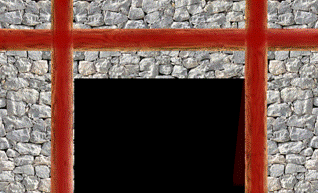
tomato or beet sauce. Now on the middle of the plate, I want you to paint the
doorposts. It will look like an exaggerated Hebrew letter chet (ח), some ways like a simple sukkot. The corners are to overlap.
See picture below for a visual.
Let’s
pray.
God, we thank You for Your love for us. We are
sorry we have sinned and violated Your law. Please
teach us to understand and love Your Law. Thank You for sending Jesus as our
Messiah and Savior. Help us to learn what it means to start a covenant with You and to build on it. Teach us how to walk more in Your ways, and how to leave behind the sins that hurt us and
those we love. Teach us also how to share Your Word and teachings with others.
Please grow us in hunger for Your Word. We love You
and thank You and Praise you, in the Name of our Messiah, Jesus, amen.
See you next year!